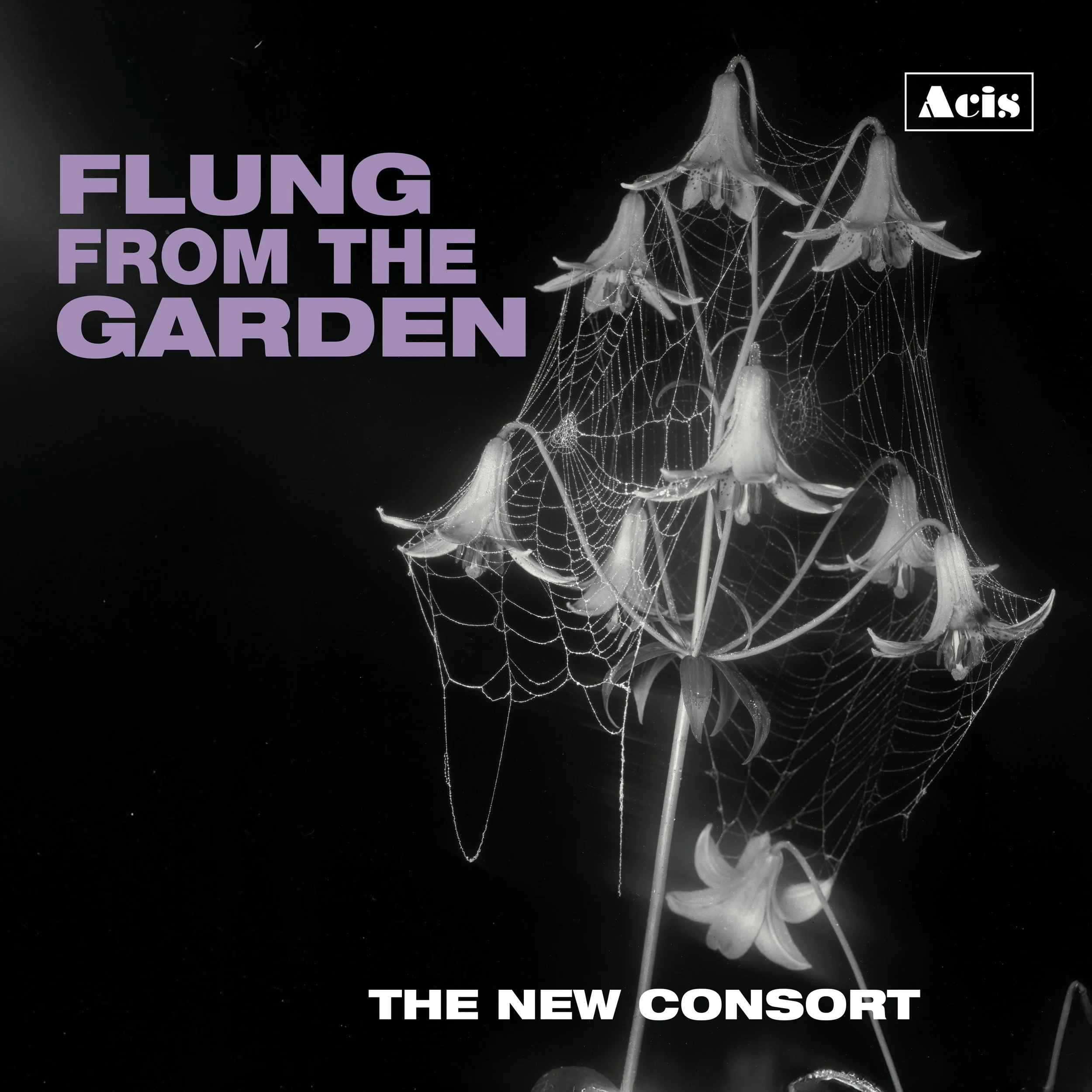
The New Consort’s Debut Album, Streaming Now
FLUNG FROM
THE GARDEN
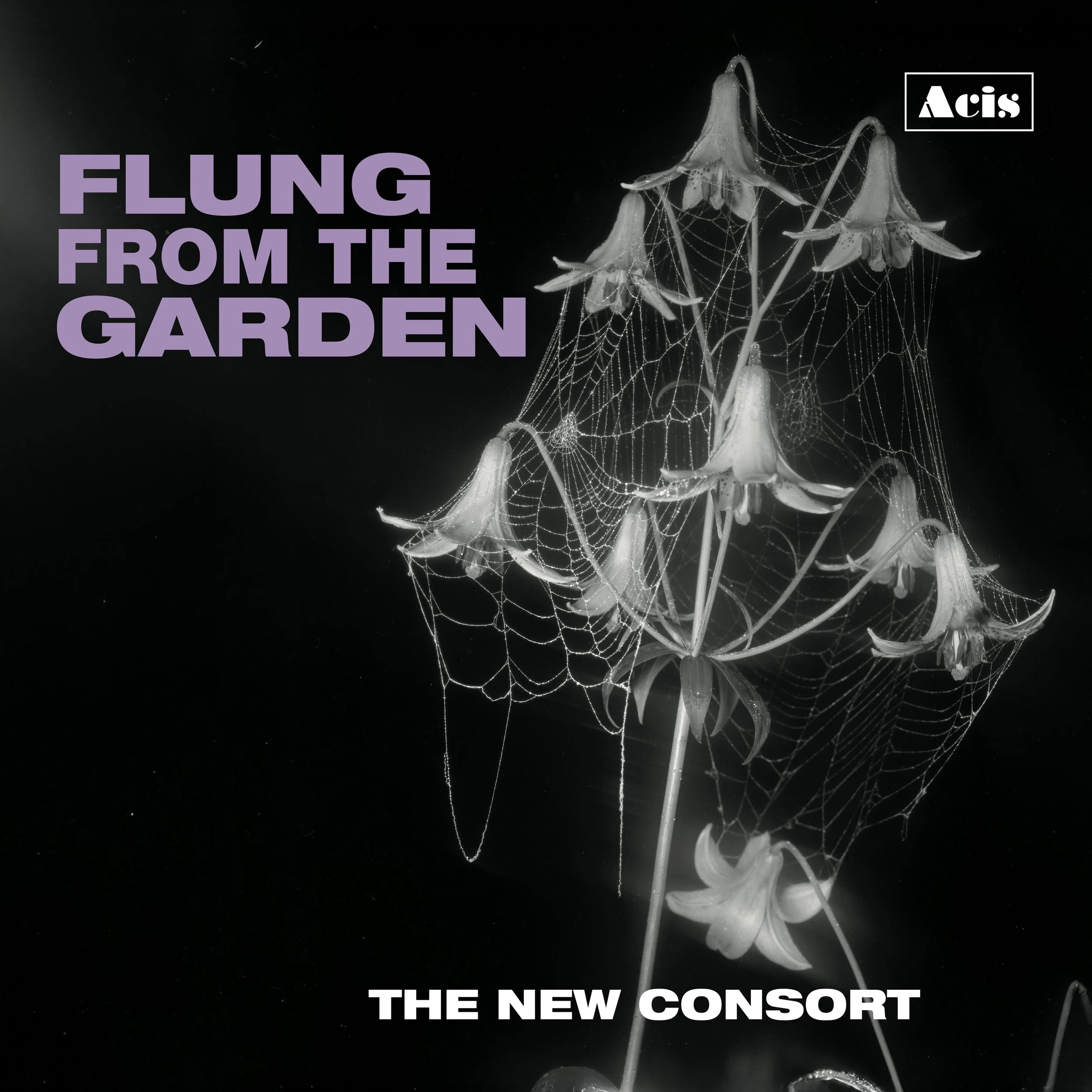
As an unrepentant musical magpie, I’ve grown used to expounding the virtues of my favorite new corner of the repertoire, while even other musicians listen with a look of blank unrecognition. Case in point: my two-decade love affair with Tudor and Elizabethan polyphony, particularly the music of Robert White. White was enormously respected in his own time, working as organist and Master of the Choristers of Westminster Abbey starting at age 32. However, only four years after arriving at the Abbey, he and his whole family succumbed to the plague – and he was virtually forgotten for centuries after his 1574 passing. White’s Lamentations a5, one of two major works on Flung from the Garden, sets the first chapter of the Lamentations of Jeremiah, whose writings upon seeing the destruction of Jerusalem in 587 BCE remain visceral in their distress and grief. As a composer in newly Protestant England, White was one of many recusant Catholics who set this text as an allegory of mourning: the Church of England’s schism from Catholicism seemed to him an event as tragic as the sacking of Solomon’s temple.
The melancholy music of these religious dissidents (whose ranks also include the more-famous William Byrd and Thomas Tallis) captures an experience of outsiderdom to which I feel real kinship. However, my affection for this repertoire is complicated; though I often find myself moved by the poetry and history of Biblical texts, I don’t believe in God in any traditional sense. Furthermore, as a gay man, I can’t imagine that either they or their sixteenth-century Catholicism would look kindly on my, ahem, “lifestyle.”
Why, then, does this music speak to me so deeply? Just as White saw in an ancient Jewish text an allegory for his time, I hear in White’s Lamentations a5 a piece that cuts through the particulars of circumstance and allows us to communicate with listeners at a more profound level. The grief, the anger, the desire for reconciliation expressed here – these are emotions we have all encountered over the last several years as we watch institutions degrade, communities turn against each other, and isolation grow in the wake of a pandemic and the proliferation of addictive, anti-human algorithms.
Much of my programming for The New Consort juxtaposes pieces that share an emotional core, but speak to a broad variety of experiences. Jonathan Woody’s remarkable new work, Lamentation, considers ways in which queer people are othered, excluded, and told they are wrong or inadequate in 2026. The piece is deeply inspired by Robert White’s incomplete Lamentations a6 – including the incorporation of musical material from the work’s shorter movements, which set Hebrew letters that intersperse Jeremiah’s biblical lament. It’s hard to imagine a better allegory for the queer experience of not-enoughness than drawing musical material from a piece that’s been missing its tenor line for centuries. Woody underlines this feeling of incompleteness by threading newly-composed vocal lines through sampled sections of Tudor material, incorporating hate speech directed at LGBTQ+ people sourced from social media.
Lamentation engages with the challenges of the minority experience, but also its unexpected gifts. The texts Woody sets illuminate many facets of the queer experience, and its responses to external messages of inadequacy. We see the cruelty metastasizing within the gay dating scene in “Preference,” and the widespread adolescent desire for conformity in “As a Gay Man, I’ll Never Be Normal.” But we also get to experience discovery and queer joy – a meditation about speaking your queerness aloud, and how it changes the way you say everything, in “Carrying in the Mouth”; or the erotically charged admiration of Sappho’s ode to someone who has not allowed external pressures to change her in “Fragment 105(a).”
Woody ends his piece by returning to White’s musical material, but pairing it with a new text: “quia terribiliter magnificatus es,” or “for I am fearfully and wonderfully made.” Repurposing the Bible’s own declaration of human worthiness rebukes the contemporary Christian right’s treatment of LGBTQ+ people, insisting that even according to their own holy text, queer people deserve the same respect, dignity, and grace as every other human.
Catholics in England and queer people in America are, of course, not the only groups to have undergone experiences of exclusion. Loss and rejection are pieces of the universal human experience – as is the particular bittersweet satisfaction in finding meaning and purpose in a struggle for justice and free expression. I hope Flung from the Garden can be for you, regardless of your spiritual journey, a chance to sit with us in that place of mingling emotions: distress at life’s cruelty, yes, but also awe at its surprising beauty, and hope for its improvement at the hands of those who imagine a better world.
-Brian Mummert
The commission of Jonathan Woody’s Lamentation has been made possible by the Chamber Music America Classical Commissioning Program, with generous funding provided by The Mellon Foundation.
Drawing on themes of otherness, exclusion, and hope for reconciliation, Flung from the Garden traverses repertoire from the Renaissance to the present day to contextualize its centerpiece, Jonathan Woody's LAMENTATION. Woody’s breathtaking, Tudor-inspired constellation of poetry and found text, commissioned for The New Consort, explores the complexity of the queer experience in 2026 America - both its challenges and its unexpected joys.